JORASAKUHUVIAN REPUBLIC
TTro jRD]Fs
Jorasakuhuvian Republic Constitution
Download the Constitution (PDF)Foreword
We, the people of the Jorasakuhuvian Republic, guardians of a land without armies and borders small yet proud, do establish this Constitution. Rooted in freedom, mutual respect, and the spirit of the Vasians, we honor the rights of all citizens, the voices of Indigenous peoples, and the harmony of our community. Here, leadership is a service, not a throne; every choice is by consent, and every home is a nation. With this Constitution, we commit to protecting our culture, our language, and the shared joy of living freely in our small but resilient homeland.
Chapter I - General Provisions
1. The Jorasakuhuvian Republic is a sovereign democratic republic.
2. This Constitution is the supreme law of the Jorasakuhuvian Republic. Any law, regulation, or action that is inconsistent with this Constitution shall be null and void to the extent of the inconsistency.
3. The Jorasakuhuvian Republic upholds the values of democracy, justice, equality, freedom, and peace in all aspects of governance and society.
4. All citizens of the Jorasakuhuvian Republic shall enjoy equal rights under the law. Indigenous citizens, in recognition of their historic and ongoing contributions to the Republic, shall be granted additional rights and privileges as provided by law.
5. All persons, regardless of ethnicity, race, or religion, who meet the conditions prescribed by law, may apply for citizenship of the Jorasakuhuvian Republic. The Republic shall ensure fair and equal consideration of all applications.
6. This Constitution applies to all persons, institutions, and laws within the Jorasakuhuvian Republic. No law, regulation, or governmental action shall contradict the provisions of this Constitution.
Chapter II - Governance
7. The President of the Jorasakuhuvian Republic
7.1. Any member of parliament who receives the support of at least 10% (rounded
up) of the members of parliament two weeks before the start of the election is
eligible to become a presidential candidate.
7.2. Term and Election
7.2.1. A president's term of office is 84 days from the date of assuming office
(inclusive).
7.2.2. All citizens of the Jorasakuhuvian Republic are entitled to vote for one
week starting on election day. Each citizen may cast only one vote.
7.2.3. The candidate with the most votes becomes president one week after
the election.
7.2.4. If a policy is not completed during the term due to time constraints, the candidate may be re-elected if supported by at least 20% (rounded up) of the members of parliament.
7.3. As both head of state and head of government, the president shall:
7.3.1. Legislation and Law Enforcement
7.3.1.1. Review and sign laws passed by Parliament to bring them into force.
7.3.1.2. Supervise the implementation and enforcement of laws, ensuring compliance by the executive branch.
7.3.1.3. Return laws to Parliament for further consideration when necessary.
7.3.2. Government Leadership and Policy Implementation
7.3.2.1. Formulate and promote national policies and administrative plans.
7.3.2.2. Supervise and guide government departments to ensure effective implementation of policies.
7.3.2.3. Bear ultimate responsibility for the formulation, allocation, and use of the national budget.
7.3.3. National Symbols and Etiquette
7.3.3.1. Represent the nation in state affairs and receive foreign heads of state and official envoys.
7.3.3.2. Award national honors, medals, and other commendations.
7.3.4. National Security and Emergency Powers
7.3.4.1. Responsible for national security affairs and may take necessary measures to protect the nation during emergencies.
7.3.4.2. Emergency measures must be reported to Parliament afterward for review.
7.3.5. Citizenship and Public Responsibility
7.3.5.1. Ensure observance and implementation of the Constitution and national laws.
7.3.5.2. Publish work reports to the public and accept oversight from Parliament and citizens.
7.3.5.3. Promote national development and safeguard citizens' interests and social order.
7.4. Limitations of Presidential Power
7.4.1. The president must comply with the Constitution and laws and may not exceed constitutionally granted powers.
7.4.2. The president may not interfere in parliamentary legislative procedures or judicial decisions, nor meddle in matters outside routine administration.
7.4.3. The president may not amend any constitutional provision concerning democracy, elections, or civil rights; any attempt is invalid.
7.4.4. When exercising emergency powers, the president must report to Parliament afterward and accept parliamentary and public oversight.
7.4.5. The president may not use powers for personal gain or to harm national interests or citizens' rights.
7.5. Presidential Duties
7.5.1. Faithfully perform duties entrusted by the Constitution and laws, safeguarding national interests and citizens' rights.
7.5.2. Issue public reports to Parliament and citizens every 14 to 21 days.
7.5.3. Ensure government policies are implemented transparently, impartially, and efficiently.
7.5.4. Respect democratic principles and refrain from abusing power or infringing on fundamental civil rights.
7.6. Impeachment and Exceptional Circumstances
7.6.1. Parliament may impeach the president for serious dereliction of duty, legal violations, or abuse of power.
7.6.2. Impeachment proceedings require at least 20% of members of Parliament to participate and a vote difference of at least 15 percentage points.
7.6.3. Upon successful impeachment, the president is immediately suspended, and preparations for a new election begin.
7.6.4. The president remains legally responsible for actions causing significant national damage during the term.
7.7. Departure and Succession
7.7.1. At term expiration or early departure, a smooth transition must be ensured for continued government operation.
7.7.2. Former presidents may not interfere in state affairs but retain entitled honors and security guarantees.
7.7.3. An impeached president is ineligible to run for office for five terms.
8. The Parliament of the Jorasakuhuvian Republic
8.1. Composition
8.1.1. The Parliament is composed of elected members, all of whom must be citizens of Jorasakuhuvo.
8.1.2. The initial number of members is 10. For every additional 500 citizens, 3 more members are added.
8.1.3. The total number of members shall not exceed 600.
8.2. Eligibility of Members
8.2.1. Must be 15 years of age or older and possess language skills in Jorasakuhuvian and English.
8.2.2. Must have no serious criminal record as determined by law.
8.3. Parliamentary Duties
8.3.1. Develop, review, and pass laws and budgets.
8.3.2. Review government work reports and monitor policy implementation.
8.3.3. Impeach the president and other senior officials (see Section 7.6).
8.4. Voting Rules and Validity
8.4.1. All motions, appointments, or resolutions must be passed by a vote in Parliament.
8.4.2. At least 95% of members must be present for the vote.
8.4.3. The difference in votes between two options must be no less than 15%; otherwise, the vote is invalid.
8.4.4. Invalid motions must be resubmitted for a vote.
8.5. Special Procedures
8.5.1. For matters of national security, budget, or presidential impeachment, Parliament may establish additional procedures to ensure discussion and transparency.
8.5.2. Parliament may establish internal rules to guarantee fair, impartial, and verifiable voting.
9. Judiciary and Independent Oversight
9.1. Judicial Independence
9.1.1. The judiciary is independent and ensures implementation of the Constitution and laws, safeguarding citizens' rights and social order.
9.1.2. No state organ, individual, or group may interfere with judicial power.
9.2. Supreme Court
9.2.1. The Supreme Court is the highest judicial authority, adjudicating constitutional, major legal, and administrative disputes.
9.2.2. Judges are nominated by the president and appointed with parliamentary approval. Term lengths ensure independence and impartiality.
9.3. Independent Oversight Body
9.3.1. Monitors administrative actions and government expenditures
9.3.2. Reviews policy implementation and budgets, reporting findings to Parliament and the public.
9.3.3. Resolutions and reports are not subject to interference by the president or government.
9.4. Protection of Citizens' Rights
9.4.1. Judicial and oversight bodies guarantee constitutional rights, including freedoms of speech, publication, election, and religion.
9.4.2. Citizens may apply to these bodies for redress to protect their legitimate rights.
9.5. Emergency Powers
9.5.1. Even in emergencies, judicial and oversight bodies exercise powers according to law without violating democratic principles.
9.5.2. Emergency actions must be reported to Parliament afterward and are subject to oversight.
10. Constitutional Authority and Amendment
10.1. Supreme Authority of the Constitution
10.1.1. The Constitution is the supreme law of the Republic; all state organs, officials, and citizens must comply.
10.1.2. No provision, especially those on democracy and civil rights, may be violated.
10.2. Principles of Amendment
10.2.1. Amendments must adhere to democracy, fairness, and transparency.
10.2.2. Amendments may not diminish civil rights or the powers of Parliament, the judiciary, or oversight bodies.
10.2.3. Core democratic elements, including voting rights, parliamentary powers, presidential limitations, and civil liberties, cannot be amended.
10.3. Amendment Procedure
10.3.1. Proposals must be initiated by at least one-third of members of Parliament.
10.3.2. Passage requires a vote difference of at least 15% between options (see Section 7.6.2).
10.3.3. Amendments must be signed by the president but must not alter core democratic principles.
10.3.4. The process must be open and transparent for citizen oversight.
10.4. Constitutional Safeguards
10.4.1. The judiciary may review any law, administrative action, or amendment to ensure consistency with the Constitution.
10.4.2. The independent oversight body monitors implementation and may report violations to Parliament and the public.
11. National Fiscal and Budgetary Principles
11.1. Voluntary Service of Officials
11.1.1. All government officials shall serve without receiving any salary.
11.1.2. Participation in government work is strictly voluntary, reflecting commitment to the public interest.
11.2. Allocation of State Revenue
11.2.1. National revenue shall be primarily used to ensure national stability and the welfare of indigenous citizens.
11.2.2. Expenditures must prioritize essential services, security, and the livelihoods of the original population.
11.3. Transparency and Oversight
11.3.1. All government financial activities shall be transparent.
11.3.2. The independent oversight body shall monitor revenue and expenditure to ensure compliance with constitutional priorities.
11.4. Emergency Fiscal Measures
11.4.1. In exceptional circumstances affecting national security or stability, the president may propose temporary fiscal measures.
11.4.2. All such measures must be reported to Parliament and are subject to subsequent review.
Chapter III - Rights of Citizens
12. Fundamental Rights
12.1. Freedom of Expression and Political Activity
12.1.1. Citizens have the right to express their opinions freely and participate in peaceful political activities.
12.1.2. Political parties are not permitted; citizens may engage in political discussion, advocacy, and community governance voluntarily.
12.2. Voting and Eligibility for Public Office
12.2.1. All citizens aged 15 or older have the right to vote in elections.
12.2.2. Citizens may run for public office if they meet the eligibility requirements established by the Constitution and law.
12.3. Equality Before the Law
12.3.1. All citizens are equal before the law and enjoy equal protection and treatment in all legal and administrative matters.
12.4. Protection of Personal Property and Privacy
12.4.1. Citizens’ personal property shall be protected from unlawful seizure or interference.
12.4.2. Citizens have the right to privacy in personal, family, and
communications matters.
12.5. Right to Appeal and Oversight
12.5.1. Citizens have the right to appeal government decisions and seek redress in accordance with the law.
12.5.2. Citizens may petition independent oversight bodies or Parliament to review administrative actions.
12.6. Freedom of Association
12.6.1. Citizens have the right to form voluntary associations for cultural, social, or professional purposes.
12.6.2. Formation of political parties is prohibited, but non-political associations are protected.
12.7. Citizenship Rights
12.7.1. Citizens may voluntarily renounce their citizenship in accordance with law and procedures.
12.8. Exemptions from Obligations
12.8.1. Citizens are exempt from compulsory military service.
12.8.2. Citizens are exempt from taxation unless otherwise determined by law.
12.9. Freedom from Compulsory Loyalty
12.9.1. No person may compel another citizen to express loyalty orallegiance.
12.9.2. Citizens are free to hold and express their own opinions, beliefs, and feelings, provided that such expressions do not infringe upon the rights or well-being of others.
13. Rights of Indigenous Citizens
13.1. All land within the Jorasakuhuvian Republic belongs collectively to the
indigenous citizen group (Vaso Jorasakuhuvian).
13.2. Indigenous Leadership Elections
13.2.1. Indigenous citizens have the right to hold leadership elections among themselves at each presidential transition.
13.2.2. All indigenous citizens aged 15 or older are eligible to vote in these elections.
13.3. All indigenous citizens have the right to join Parliament and to stand as
presidential candidates, in accordance with the eligibility rules in the
Constitution.
13.4. Consent for Land Changes
13.4.1. The government must notify indigenous citizens and obtain their consent before any changes to land ownership or use.
13.4.2. Indigenous citizens have seven (7) days to respond to proposed land changes. If no response is given within this period, consent is deemed granted by default.
13.5. Indigenous citizens enjoy all other rights and protections granted to all citizens under this Constitution.
13.6. Ordinary domestic policies, unless directly affecting land ownership, do not require notification or consent from indigenous citizens.
13.7. Right to Reclaim Land
13.7.1. Indigenous citizens have the right to request the government to return any land that is rightfully theirs.
13.7.2. The government must respond to such requests in a timely manner and take necessary measures to restore ownership or use rights to the indigenous citizen group.
13.7.3. This right does not affect other citizens' lawful rights, but ensures the protection and restoration of indigenous land ownership.
14. Duties and Responsibilities of Citizens
14.1. Obedience to the Constitution and Laws
14.1.1. All citizens must respect and abide by the Constitution and laws of the Jorasakuhuvian Republic.
14.1.2. Citizens shall not engage in actions that undermine national stability, public order, or the rights of others.
14.2. Citizens must respect the rights and freedoms of other citizens, including indigenous citizens, ensuring that personal actions do not harm others.
14.3. Participation in Public Affairs
14.3.1. Citizens are encouraged to participate in elections, public decision-making, and civic activities.
14.3.2. Citizens may voluntarily contribute to the oversight of government policies and the administration of public projects.
14.4. Protection of National Resources and Culture
14.4.1. Citizens shall respect and protect the land, natural resources, and environment, particularly lands belonging to indigenous citizens.
14.4.2. Citizens shall promote and preserve the language, culture, and heritage of the Jorasakuhuvian Republic.
14.5. In times of emergency or public crisis, citizens may be called upon to provide voluntary support to ensure the safety, security, and welfare of the nation and its people.
Chapter IV - National Symbols and Territory
15. National Symbols
15.1. National Symbols
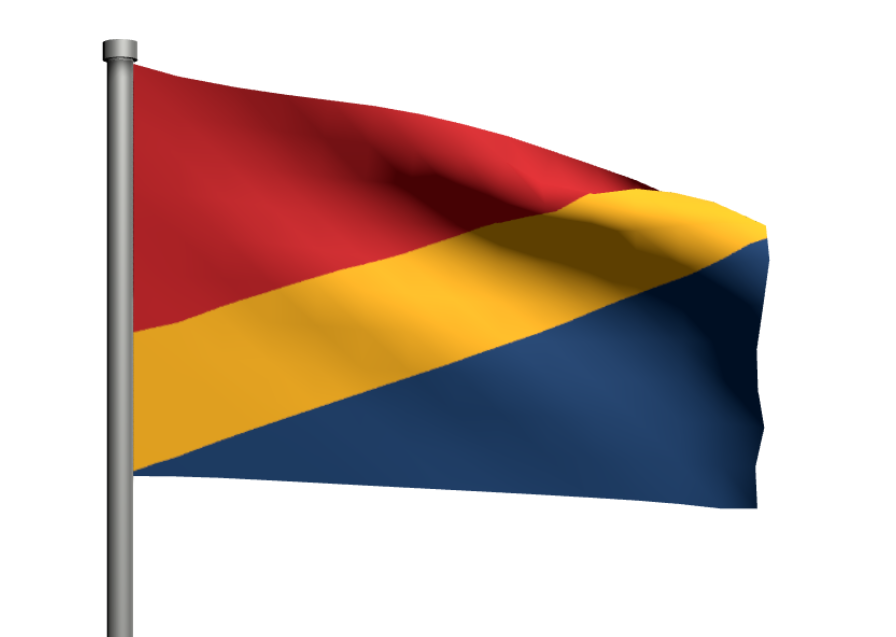
15.1.1. The Jorasakuhuvian Republic shall have a national flag representing its sovereignty and values.
15.1.2. The detailed drawing method is as follows:
15.1.2.1. The flag of the Jorasakuhuvian Republic should be drawn on a rectangular canvas with an initial size of 1194 × 826 units. Once completed, it can be scaled proportionally to the standard flag size, 413 units in height and 597 units in width, to ensure consistent proportions.
15.1.2.2. A right-angled triangle should be placed in the upper left corner of the national flag, with its right angle located at the upper left corner of the canvas. The two right sides of the triangle extend along the top and left sides of the canvas, with the base and height each measuring 1194 × 548 units, and filled with red (#C00F19). The triangle extends from the upper left corner to the lower right.
15.1.2.3. A parallelogram should be placed in the center of the national flag, with a base width of 278 units. The base of the parallelogram should be placed in the lower left corner of the canvas, and the vertex should be placed in the upper right corner. The parallelogram should be filled with yellow (#F8AF0A) and form a diagonal band with the red and blue triangles, sloping from the lower left to the upper right.
15.1.2.4. A right-angled triangle should be placed at the lower right corner of the national flag, with its right angle located at the lower right corner of the canvas. The two right sides of the triangle extend along the right and bottom edges of the canvas, with the base and height each measuring 1194 × 548 units, and filled with blue (#00386A). The triangle extends from the lower right corner towards the upper left.
15.1.2.5. Once drawn, the national flag should be scaled up to 413 units in height and 597 units in width to ensure that the relative positions, sizes, colors, and angles of the triangles and diagonal stripes remain unchanged, in order to maintain the overall visual consistency and standard of the national flag.
15.1.3. The flag of the Jorasakuhuvian Republic can be used in any way, and there is no mandatory requirement to respect it.
15.2. National Emblem
15.2.1. The coat of arms of the Jorasakuhuvian Republic is a symmetrical graphic and a symbol of the indigenous people.
15.2.2. It represents the courage and selflessness of the indigenous people, as well as the fairness and stability of the national system.
15.3. National Anthem
15.3.1. The Jorasakuhuvian Republic does not have an officially designated national anthem.
15.3.2. The version used in daily life is the widely circulated one.
15.4. Official Locations and Capital
15.4.1. The territory of the Jorasakuhuvian Republic is a quadrilateral formed by the following four points:
18.68214 N 98.87734 E,
18.68210 N 98.87721 E,
18.68190 N 98.87732 E,
and 18.68195 N 98.87745 E.
15.4.2. The capital of the Jorasakuhuvian Republic is Fitahuna, or more fully, Fitahunateterepejorasakuhuvok.
15.4.3. The above constitution is only in effect within the Jorasakuhuvian Republic.